Galactic bar
Integrate the globular cluster system as point masses where the galaxy now includes a galactic bar. Thus, we no are no longer in a time-static and axis-symmetric potential
[1]:
import tstrippy
import astropy.units as u
import astropy.constants as const
import astropy.coordinates as coord
import numpy as np
import matplotlib.pyplot as plt
Load the units
[2]:
unitbasis = tstrippy.Parsers.potential_parameters.unitbasis
unitT=u.Unit(unitbasis['time'])
unitV=u.Unit(unitbasis['velocity'])
unitD=u.Unit(unitbasis['distance'])
unitM=u.Unit(unitbasis['mass'])
unitG=u.Unit(unitbasis['G'])
G = const.G.to(unitG).value
Load Galactic Parameters
[3]:
potentialname='pouliasis2017pii'
MWparams = tstrippy.Parsers.potential_parameters.pouliasis2017pii()
MWrefframe= tstrippy.Parsers.potential_parameters.MWreferenceframe()
Add the bar parameters
This is an artificial bar used in Ferrone et al 2023. It is not intended to perfectly model the bar, but rather provide an idea of what a bar can do to stellar streams. It uses a Long-Murali bar. This bar is a needle that has been convolved with a soften kernal to give it a triaxial-shape.
[4]:
# mass and size
abar = 4 * unitD
bbar = 1 * unitD
cbar = 0.5 * unitD
Mbar = 990.0*2.32*1e7 * unitM
barname = "longmuralibar"
barparams = [MWparams[0],Mbar.value,abar.value,bbar.value,cbar.value]
# oreitnation and bar pattern speed
theta0= 25 * (np.pi/180)
omega =  28  * unitV / unitD
omega = -omega.value
barpolycoeff=[theta0,omega]
Reduce the mass of the disks
Since we are adding a bar, we need to reduce the mass of the disks
[5]:
MWparams[5] = 1120.0 * 2.32*10**7
MWparams[8] = 1190.0 * 2.32*10**7
Set integration time
Do this in years so that you can assure the number of timesteps is an integer, and then convert the total time T and the timestep dt into integration units.
[6]:
integrationtime,dt = 5e9,1e5
Ntimestep=int(integrationtime/dt)
integrationtime,dt=integrationtime*u.yr,dt*u.yr
dt=dt.to(unitT)
currenttime = 0.0*unitT
integrationparams = [currenttime,dt,Ntimestep]
Load the Globular Clusters
Store them in an astropy object to store them to galactocentric coordinates
[7]:
GCdata  =   tstrippy.Parsers.baumgardtMWGCs().data
skycoordinates=coord.SkyCoord(
    ra=GCdata['RA'],
    dec=GCdata['DEC'],
    distance=GCdata['Rsun'],
    pm_ra_cosdec=GCdata['mualpha'],
    pm_dec=GCdata['mu_delta'],
    radial_velocity=GCdata['RV'],)
galacticcoordinates = skycoordinates.transform_to(MWrefframe)
x,y,z=galacticcoordinates.cartesian.xyz.to(unitD).value
vx,vy,vz=galacticcoordinates.velocity.d_xyz.to(unitV).value
# grab the number of objects
Nobj=len(x)
Initialize the integrator
organize the input arguments
[8]:
staticgalaxy = [potentialname,MWparams]
initialkinematics = [x,y,z,vx,vy,vz]
integrationparams = [currenttime.value,dt.value,Ntimestep]
galacticbar = [barname,barparams,barpolycoeff]
leapfropintime = [Ntimestep,Nobj]
input the arguments and compute the integral
[9]:
tstrippy.integrator.setstaticgalaxy(*staticgalaxy)
tstrippy.integrator.setinitialkinematics(*initialkinematics)
tstrippy.integrator.setintegrationparameters(*integrationparams)
# tstrippy.integrator.setbackwardorbit()
tstrippy.integrator.initgalacticbar(*galacticbar)
xt,yt,zt,vxt,vyt,vzt=tstrippy.integrator.leapfrogintime(*leapfropintime)
timestamps = tstrippy.integrator.timestamps.copy()
tstrippy.integrator.deallocate()
Analyize the change in energy
[10]:
def transform_to_bar_frame(x,y,z,barpolycoeff,thetime):
    """
    Transform the coordinates to the bar frame
    """
    theta0,omega=barpolycoeff
    theta=theta0+omega*thetime
    xbar=x*np.cos(theta)+y*np.sin(theta)
    ybar=-x*np.sin(theta)+y*np.cos(theta)
    zbar=z
    return xbar,ybar,zbar
[11]:
E0 = np.zeros(Nobj)
_,_,_,phi0=tstrippy.potentials.pouliasis2017pii(MWparams,xt[:,0],yt[:,0],zt[:,0])
_,_,_,phiF=tstrippy.potentials.pouliasis2017pii(MWparams,xt[:,-1],yt[:,-1],zt[:,-1])
T0 = 0.5*(vxt[:,0]**2+vyt[:,0]**2+vzt[:,0]**2)
TF = 0.5*(vxt[:,-1]**2+vyt[:,-1]**2+vzt[:,-1]**2)

# grab the bar, who changes in time
xbar0,ybar0,zbar0=transform_to_bar_frame(xt[:,0],yt[:,0],zt[:,0],barpolycoeff,timestamps[0])
xbarF,ybarF,zbarF=transform_to_bar_frame(xt[:,-1],yt[:,-1],zt[:,-1],barpolycoeff,timestamps[-1])
_,_,_,phibar0=tstrippy.potentials.longmuralibar(barparams,xbar0,ybar0,zbar0)
_,_,_,phibarF=tstrippy.potentials.longmuralibar(barparams,xbarF,ybarF,zbarF)

E0 = T0 + phi0 + phibar0
EF = TF + phiF + phibarF
Lz0 = xt[:,0]*vyt[:,0]-yt[:,0]*vxt[:,0]
LzF = xt[:,-1]*vyt[:,-1]-yt[:,-1]*vxt[:,-1]
[12]:
import matplotlib
colors = matplotlib.cm.rainbow(np.linspace(0,1,Nobj))
# make the font size bigger and also us Latex font
plt.rc('text', usetex=True)
plt.rc('font', size=20)
plt.rc('axes', titlesize=20)
plt.rc('axes', labelsize=20)
plt.rc('xtick', labelsize=20)
plt.rc('ytick', labelsize=20)
plt.rc('legend', fontsize=20)
plt.rc('figure', titlesize=20)
[13]:
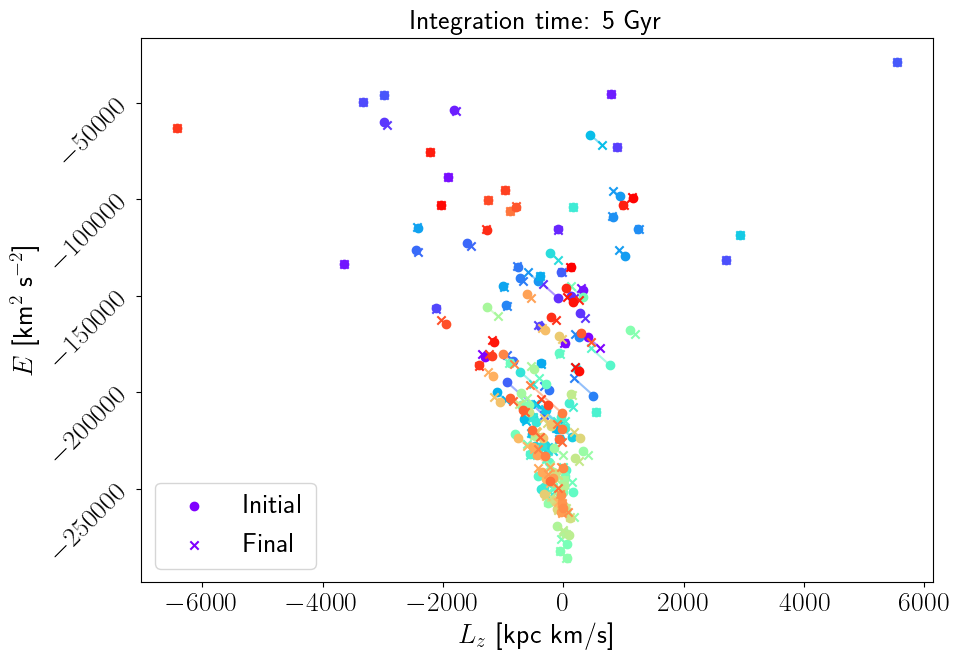
fig,axis=plt.subplots(1,1,figsize=(10,7))
AXIS = {
    "xlabel": r"$L_z$ [kpc km/s]",
    "ylabel": r"$E$ [km$^{2}$ s$^{-2}$]",
    "title": "Integration time: {:d} Gyr".format(int(integrationtime.to(u.Gyr).value)),
}
for i in range(Nobj):
    if i ==0:
        axis.scatter(Lz0[i],E0[i],color=colors[i],label="Initial")
        axis.scatter(LzF[i],EF[i],color=colors[i],marker='x',label="Final")
    else:
        axis.scatter(Lz0[i],E0[i],color=colors[i])
        axis.scatter(LzF[i],EF[i],color=colors[i],marker='x')
    axis.plot([Lz0[i],LzF[i]],[E0[i],EF[i]],color=colors[i],alpha=0.5,zorder=0)
axis.set(**AXIS)
axis.tick_params(axis='y', rotation=45)
axis.legend()
fig.tight_layout()
View the most relatively changed clusters
[14]:
dE = np.abs(E0 - EF)
dLz = np.abs(Lz0 - LzF)
meanE = np.mean(dE)
meanLz = np.mean(dLz)
metric = np.sqrt((dE/meanE)**2 + (dLz/meanLz)**2)
top4=np.argsort(metric)[-5:-1]
# targetGC = "NGC5139"
for i in top4:
    print("GC: {:s} has metric: {:.2f}".format(GCdata['Cluster'][i],metric[i]))
GC: Gran2 has metric: 5.78
GC: NGC5946 has metric: 7.36
GC: NGC6681 has metric: 9.54
GC: NGC4372 has metric: 10.93
[15]:
nstamps = len(timestamps)
colors = matplotlib.cm.rainbow(np.linspace(0,1,nstamps))
[16]:
fig= plt.figure(figsize=(12,10))
gridspec=fig.add_gridspec(2,3,width_ratios=[1,1,0.05],height_ratios=[1,1])
axes=[[],[]]
axes[0].append(fig.add_subplot(gridspec[0,0]))
axes[0].append(fig.add_subplot(gridspec[0,1]))
axes[1].append(fig.add_subplot(gridspec[1,0]))
axes[1].append(fig.add_subplot(gridspec[1,1]))
caxis=fig.add_subplot(gridspec[:,2])

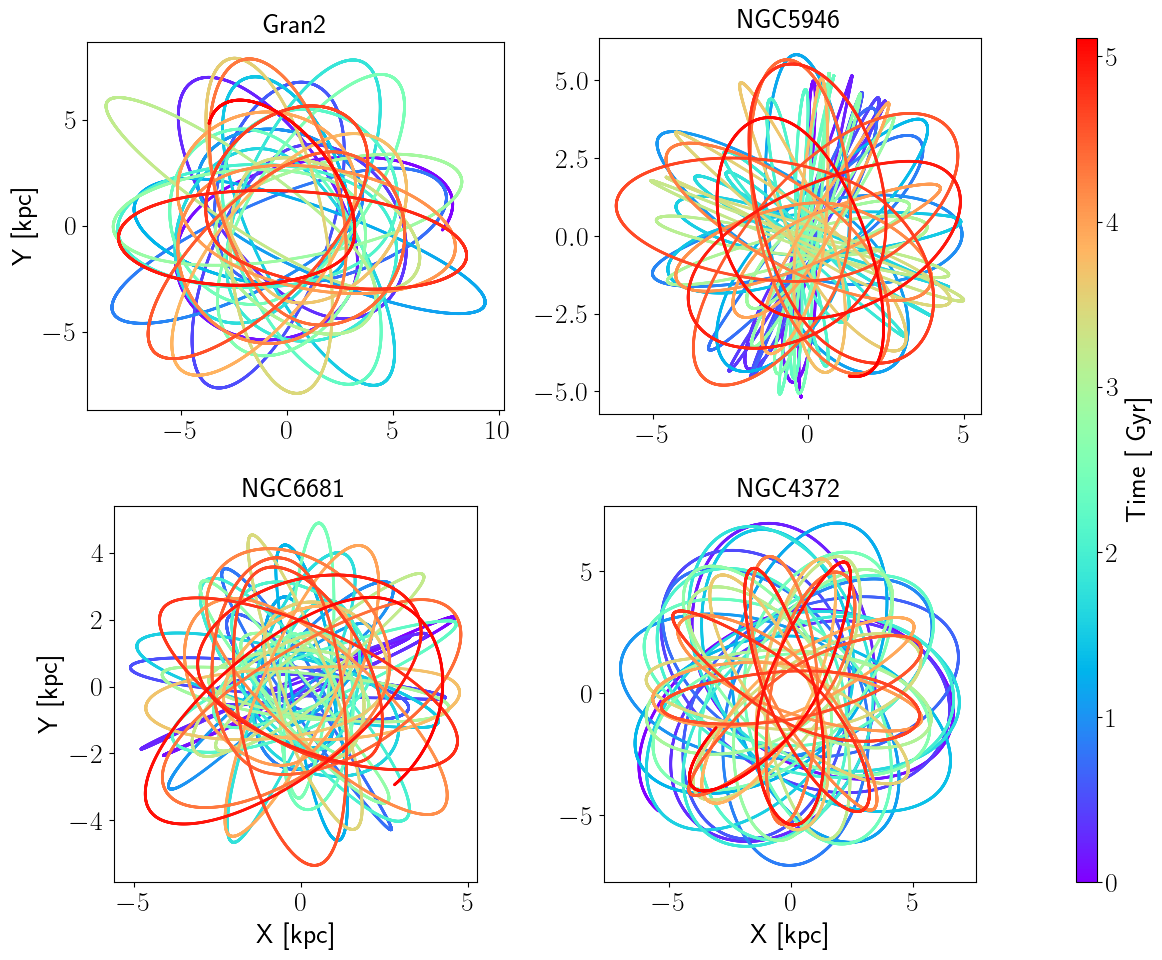
im=axes[0][0].scatter(xt[top4[0],:],yt[top4[0],:],c=timestamps,marker='o',s=1,cmap=plt.cm.rainbow)
axes[0][0].set_aspect("equal")
axes[0][0].set_title("{:s}".format(GCdata['Cluster'][top4[0]]));

axes[0][0].set_ylabel("Y [kpc]");

im=axes[0][1].scatter(xt[top4[1],:],yt[top4[1],:],c=timestamps,marker='o',s=1,cmap=plt.cm.rainbow)
axes[0][1].set_aspect("equal")
axes[0][1].set_title("{:s}".format(GCdata['Cluster'][top4[1]]));


im=axes[1][0].scatter(xt[top4[2],:],yt[top4[2],:],c=timestamps,marker='o',s=1,cmap=plt.cm.rainbow)
axes[1][0].set_aspect("equal")
axes[1][0].set_title("{:s}".format(GCdata['Cluster'][top4[2]]));
axes[1][0].set_xlabel("X [kpc]");
axes[1][0].set_ylabel("Y [kpc]");

axes[1][1].scatter(xt[top4[3],:],yt[top4[3],:],c=timestamps,marker='o',s=1,cmap=plt.cm.rainbow)
axes[1][1].set_aspect("equal")
axes[1][1].set_title("{:s}".format(GCdata['Cluster'][top4[3]]));
axes[1][1].set_xlabel("X [kpc]");


cbar=fig.colorbar(im,cax=caxis,orientation='vertical')
cbar.set_label("Time [~Gyr]")
fig.tight_layout()
Co-rotation frame
[17]:
fig= plt.figure(figsize=(12,10))
gridspec=fig.add_gridspec(2,3,width_ratios=[1,1,0.05],height_ratios=[1,1])
axes=[[],[]]
axes[0].append(fig.add_subplot(gridspec[0,0]))
axes[0].append(fig.add_subplot(gridspec[0,1]))
axes[1].append(fig.add_subplot(gridspec[1,0]))
axes[1].append(fig.add_subplot(gridspec[1,1]))
caxis=fig.add_subplot(gridspec[:,2])

for i in range(2):
    for j in range(2):
        index = i*2+j
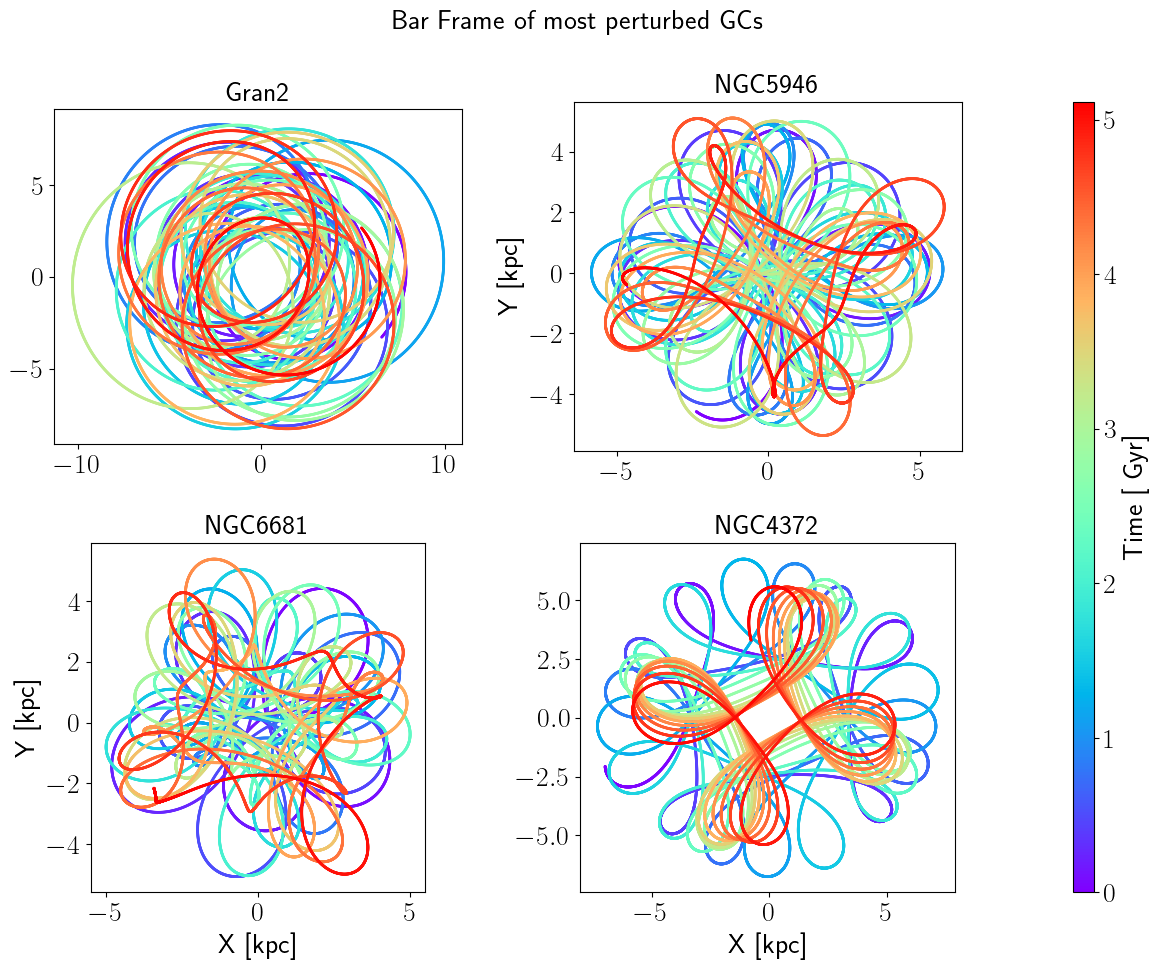
        xbar,ybar,zbar=transform_to_bar_frame(xt[top4[index],:],yt[top4[index],:],zt[top4[index],:],barpolycoeff,timestamps)
        im=axes[i][j].scatter(xbar,ybar,c=timestamps,marker='o',s=1,cmap=plt.cm.rainbow)
        axes[i][j].set_aspect("equal")
        axes[i][j].set_title("{:s}".format(GCdata['Cluster'][top4[index]]));

cbar=fig.colorbar(im,cax=caxis,orientation='vertical')
axes[1][1].set_xlabel("X [kpc]");
axes[1][0].set_xlabel("X [kpc]");
axes[1][0].set_ylabel("Y [kpc]");
axes[0][1].set_ylabel("Y [kpc]");
cbar.set_label("Time [~Gyr]")
fig.suptitle("Bar Frame of most perturbed GCs")
fig.tight_layout()